
96% of US consumers check online reviews before making a purchase, making them a key factor in attracting local customers. Reviews build trust, improve your local search visibility, and provide insights into customer needs. A single star increase in ratings can boost sales by 5–9%, and businesses that actively respond to reviews see 88% of consumers more likely to buy from them.
Here’s a quick 7-day plan to start leveraging reviews:
- Day 1: Optimize your Google Business Profile with accurate details and photos.
- Day 2: Set clear review goals and assign responsibility.
- Day 3: Create simple SMS and email templates for review requests.
- Day 4: Train your team to ask for reviews at the right moment.
- Day 5: Reach out to happy customers for reviews.
- Day 6: Monitor and respond to all reviews within 24–48 hours.
- Day 7: Record your starting metrics to track progress.
Responding to reviews, whether positive or negative, builds credibility and encourages repeat business. Use direct links or QR codes to make leaving reviews simple for customers. Over time, consistently gathering and addressing feedback will strengthen your reputation and drive more local customers to your business.
How Online Reviews Bring in More Local Customers
Reviews Build Trust and Increase Sales
Online reviews work like modern-day word-of-mouth. In fact, 85% of people trust online reviews as much as personal recommendations. When potential customers read about others’ experiences, it often helps them feel more confident about making a purchase.
Here’s an interesting stat: a single star increase in your average rating can boost sales by 5–9%. Plus, 88% of consumers are more likely to buy from a business that actively responds to reviews. That interaction shows you’re engaged and care about your customers’ feedback.
Another key factor? Many shoppers filter businesses by ratings. Seventy percent of consumers use rating filters, with 35% looking for businesses rated 4 stars or higher, while only 11% consider brands rated 2 stars.
But here’s something to keep in mind: perfect 5-star ratings can sometimes raise eyebrows. About 44% of consumers find flawless ratings suspicious. A mix of positive reviews and the occasional constructive critique feels more genuine and builds trust.
"How you handle criticism can often say more about your business than the initial complaint itself."
- Brianne Schaer, Reputation X
This trust doesn’t just drive sales – it also plays a role in increasing your online visibility, as we’ll explore next.
Reviews Improve Your Local Search Rankings
Beyond boosting sales, reviews can significantly enhance your local search rankings. Google considers reviews a major factor when determining where businesses appear in local search results. Key elements like your star rating, the number of reviews, and how recent those reviews are all play a role in where you rank.
Here’s a telling trend: Google star ratings moved from being the 24th to the 8th most important factor for local rankings over three years. And if your rating improves from 3 stars to 5 stars, your click-through rate can jump by 25%. This means more people visiting your website, calling your business, and even walking through your doors – 53% of people who search for local businesses visit a physical location within 48 hours.
Reviews also help your business show up for specific searches. For instance, Google pulls key phrases from reviews, like “gluten-free pizza” or “fast service,” to match search queries. And don’t underestimate how important freshness is – 67% of consumers say recent reviews are the most influential factor when choosing a local business.
Reviews Show You What Customers Want
Reviews aren’t just about building trust or improving search rankings – they’re also a goldmine of customer insights. Think of them as free market research. Around 38% of consumers write reviews to share how a business can improve. That feedback can help you identify what’s working and what needs attention.
Look for recurring themes in your reviews. For instance, 65% of negative reviews mention poor or rude customer service, while 63% highlight product issues. These patterns can pinpoint areas where improvements are needed.
"Negative reviews, when fairly given, are a priceless form of free quality control for the brand. Customers directly tell the brand which problems need to be fixed to make them happy."
- Miriam Ellis, Local SEO Subject Matter Expert, Moz
Reviews can also uncover issues you might not notice on your own. For example, 23% of negative reviews stem from incorrect online information, like wrong hours or addresses, and 28% result from businesses failing to address complaints on-site.
How to Get More Local Business Reviews in 2026 The Right Way
Setting Up Your Review Foundation
Before diving into collecting reviews, it’s crucial to have a strong foundation in place. Without this groundwork, even the best strategies can fall flat. Let’s start by covering the essentials.
Set Up Your Google Business Profile
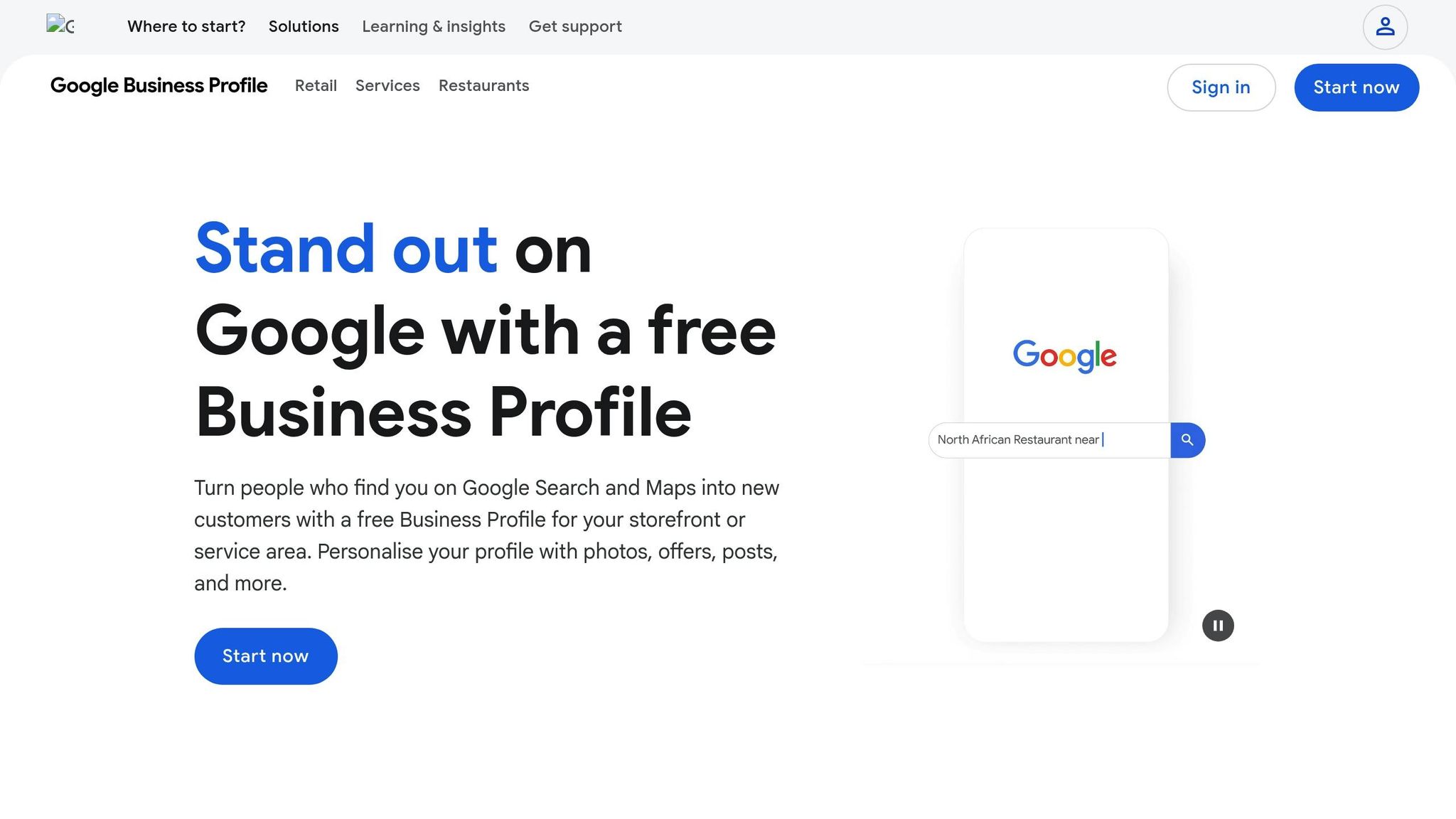
Your Google Business Profile (GBP) is the cornerstone for local reviews. It’s free, easy to manage, and incredibly impactful. Did you know that users are 70% more likely to visit a business with a complete profile? Even better, 50% of customers are more likely to make a purchase from such businesses. That’s a big deal.
To get started, create a Google Account using your company email. Keep in mind that only businesses with in-person customer interactions are eligible – whether at a storefront or at customer locations. Online-only businesses don’t qualify for a Business Profile.
Next, search for your business on Google Maps. If it’s already listed, claim it. If not, create a new profile. When filling out your business details, provide your exact name, address, and phone number (NAP). Stick to your real-world business name as it appears on your storefront and website. Adding keywords like “Best Burgers in LA” might sound tempting but can lead to account suspension.
"Your name should reflect your business’s real-world name, as used consistently on your shopfront, website, stationery and as known to customers." – Google Guidelines
Choose accurate categories for your business. Start with a primary category that broadly describes your offerings, then add sub-categories for specific services. Don’t forget to upload high-quality images, including your logo, a cover photo, and snapshots of your location or products. Profiles with photos tend to attract significantly more engagement.
Before your profile appears on Google Maps and Search, you’ll need to verify it. Google offers several verification methods, including phone, email, video, or a postcard sent by mail. Once verified, generate a custom "Ask for reviews" link in your GBP manager. This short link can be shared with customers via email, social media, or even QR codes displayed in your shop.
With your profile verified and optimized, ensure your business details are consistent across all platforms.
Keep Your Business Information Consistent Everywhere
Here’s a statistic that might surprise you: 23% of consumers have left negative reviews because of incorrect online information, such as outdated addresses, phone numbers, or hours of operation. That’s almost one in four negative reviews you could avoid by simply keeping your details accurate.
Your business name, address, and phone number (NAP) should be identical across every platform – Google, Facebook, Yelp, and any industry-specific directories like OpenTable or TripAdvisor. Even minor inconsistencies, like writing "Street" on one site and "St." on another, can confuse customers and hurt your search rankings.
Start by claiming and verifying your profiles on major platforms. Then, search for your business name along with the word “reviews” to find out where customers are already leaving feedback. This will also help you spot any outdated or incorrect information that needs fixing.
Don’t forget to update your hours of operation, including holiday schedules and special closures, across all platforms. If you manage multiple locations, consider using a centralized tool to update details across directories in one go.
Once your profiles are polished, you can amplify their impact by showcasing reviews directly on your website.
Display Reviews on Your Turbify Website
Featuring reviews on your Turbify website can significantly boost customer confidence, especially at the point of purchase. Nearly 90% of consumers read online reviews for local businesses before deciding where to spend their money. Displaying reviews on your site keeps visitors engaged and prevents them from leaving to check third-party platforms.
Place reviews strategically across your website. Highlight them on your homepage, product pages, and service pages. For example, in 2025, the online flower delivery service Flowers.ie added customer reviews to their product pages. The result? A 37% increase in purchases for those products. That’s the power of social proof.
Use a mix of first-party reviews (collected directly) and third-party badges linking to platforms like Google, Yelp, or Facebook. Including reviewer details, such as names and cities, adds authenticity and makes the feedback feel more relatable. You can also create a dedicated “Reviews” page with a "Review Us" button to encourage new submissions.
"Show your site’s credibility by using original research, citations, links, reviews and testimonials. An author biography or testimonials from real customers can help boost your site’s trustworthiness and reputation." – Google Search Console Course
Don’t shy away from negative reviews. Displaying all legitimate feedback – even the less favorable ones – demonstrates transparency and builds trust. Respond to reviews on your website just as you would on third-party platforms. This shows customers that their opinions matter and that you’re actively engaged with your community.
sbb-itb-7459f5e
Your 7-Day Plan to Get More Local Reviews
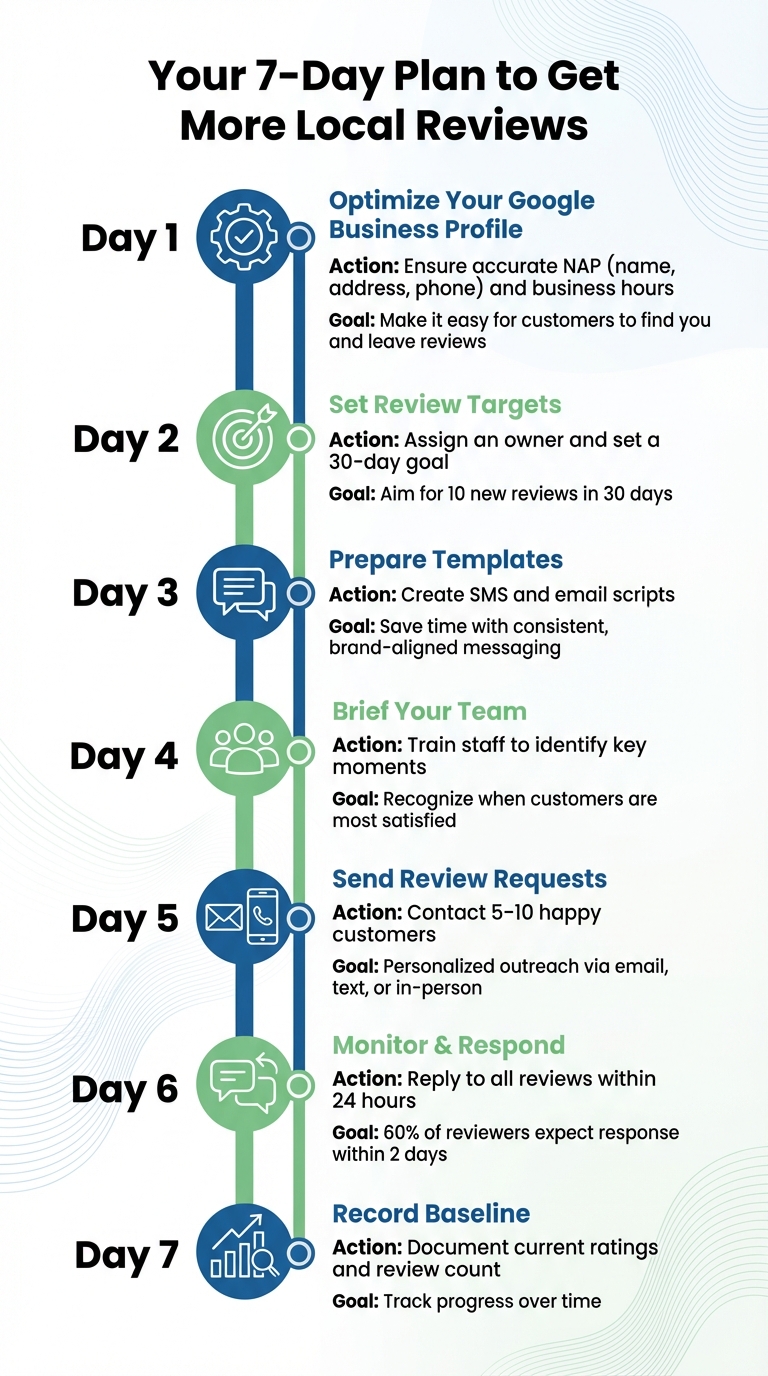
7-Day Plan to Get More Local Customer Reviews
With the groundwork in place, it’s time to actively gather reviews. Success here depends on being consistent and communicating clearly.
Daily Action Steps for Getting More Reviews
Here’s a simple seven-day plan to help you ramp up your local reviews:
Day 1: Start by optimizing your Google Business Profile. Ensure your profile is claimed, verified, and fully accurate. Double-check details like your name, address, phone number, and business hours. This makes it easy for customers to find you and leave reviews.
Day 2: Set clear goals and assign responsibility. For example, aim for 10 new reviews in the next 30 days. Assign someone, like an office manager, to oversee the process and ensure accountability.
Day 3: Draft short, brand-aligned templates for SMS and email review requests. These will save time and keep your messaging consistent.
Day 4: Brief your team. Explain why reviews matter and train them to recognize the perfect moment to ask for a review – like when a customer compliments your service or product.
Day 5: Reach out to recent happy customers. Pick 5–10 satisfied customers and send them personalized review requests through their preferred method, whether it’s email, text, or an in-person conversation.
Day 6: Monitor and respond to reviews. Check your profiles daily for new feedback and reply to every review – whether positive or negative – within 24 hours. Research shows that 60% of reviewers expect a response within two days or less.
Day 7: Establish a baseline. Record your starting metrics, like your average star rating and the total number of reviews. This will help you track progress over time.
Here’s a quick summary of the plan:
| Day | Action Item | Goal |
|---|---|---|
| Day 1 | Optimize GBP | Ensure accurate NAP (name, address, phone) and business hours |
| Day 2 | Set review targets | Assign an owner and set a 30-day goal |
| Day 3 | Prepare templates | Create SMS and email scripts |
| Day 4 | Brief your team | Train staff to identify key moments |
| Day 5 | Send review requests | Contact 5–10 happy customers |
| Day 6 | Monitor & respond | Reply to all reviews within 24 hours |
| Day 7 | Record baseline | Document current ratings and review count |
Once you’ve launched your review requests, the next step is to make it as easy as possible for your customers to leave feedback.
Make Leaving Reviews Simple for Customers
When your review campaign is in motion, focus on removing any obstacles that might discourage customers from leaving feedback. Research shows that 30% of customers skip leaving reviews because the process feels too complicated. Simplify it, and you’ll see better results.
Start by generating a direct review link from your Google Business Profile. Go to your dashboard, click “Ask for reviews,” and copy the provided URL. This link takes customers directly to the review form, eliminating unnecessary steps. Share the link via email, text, or social media.
For physical materials, like receipts or business cards, use a link shortener (e.g., Bitly) to create a clean and easy-to-remember URL (e.g., bit.ly/ReviewOurShop). You can also generate QR codes for customers to scan. These work great on table tents in restaurants, mirrors in salons, or the back of invoices.
Another option is adding a “Review Us” page to your Turbify website. This page should include direct links to your profiles on Google, Yelp, and Facebook, along with a few glowing customer reviews to inspire others. Don’t forget about email signatures – a simple line like “Loved our service? Leave us a quick review here” can gently encourage feedback.
Data shows that email review requests have a 15% response rate, while SMS requests see a 20% response rate. Even better, combining email and SMS can boost response rates to 26%. However, avoid setting up in-store tablets or kiosks for reviews, as multiple submissions from the same IP address can be flagged as spam.
How to Respond to Reviews
Collecting reviews is just the beginning – how you respond to them can significantly impact your reputation. Engaging with reviews builds trust and shows customers you care. In fact, 90% of consumers are influenced by how businesses respond to reviews, and businesses that reply to reviews can see up to 35% more revenue.
"Owner responses are free advertising. Unlike pay-per-click campaigns… owner responses are free screen real estate on some of the most influential, visible platforms on the Internet." – Moz
For positive reviews, keep your responses personal. Thank the reviewer by name and reference something specific they mentioned. You can also use this opportunity to share a tidbit, like announcing a new product or an upcoming promotion.
For negative reviews, follow a four-step approach: apologize, explain how you’ll fix the issue, thank the customer for their feedback, and provide direct contact information to resolve the matter privately. This strategy works – 62% of customers are willing to give a business a second chance if their complaint is resolved, and 58% are more likely to return if the owner offers a specific solution.
If you only get a handful of reviews each week, set aside 15 minutes weekly to respond. For higher volumes, a daily check-in might be necessary. Most importantly, never argue with reviewers – even if you disagree. 46% of potential customers avoid businesses that argue with reviewers. Your response isn’t just for the reviewer; it’s for everyone else reading it.
Take inspiration from Collective Hearts, a jewelry brand that turned a 1-star review into a 5-star success in June 2023. After a prompt and thoughtful reply addressing a shipping issue, the customer updated their review and publicly praised the resolution. This shows how professional, empathetic responses can turn challenges into opportunities.
Managing Reviews for Long-Term Growth
With your short-term review strategy in place, it’s time to think about the bigger picture – creating a system that steadily builds your online reputation over time. Quick wins are great, but lasting growth comes from a consistent, organized approach to monitoring, requesting, and leveraging reviews. This kind of system can help you attract more customers and keep them coming back.
Monitor Your Review Performance
Keep an eye on key metrics like your average star rating, total review count, and how recent your latest reviews are. These factors don’t just guide your improvement efforts – they directly influence customer decisions. For instance, 67% of consumers say recent reviews are the most important factor when choosing a business, and 60% of people won’t even consider businesses with ratings below 4 stars.
To stay on top of these numbers, track them monthly using a spreadsheet or reputation management software. Look for trends – if your average rating dips or reviews slow down, investigate what might have changed in your operations or customer experience.
Make Review Requests Part of Your Daily Workflow
Businesses that consistently gather reviews don’t leave it to chance – they automate the process. Use tools like CRM or point-of-sale systems to send review requests 24–48 hours after a purchase. This timing captures feedback while the experience is still fresh in the customer’s mind.
Additionally, train your team to ask for reviews during positive interactions. A simple, direct request at the right moment can go a long way. In fact, 51% of customers are willing to leave a review if they’re just asked. By keeping the requests steady, you’ll maintain a continuous flow of feedback that can help you fine-tune your business.
Use Customer Feedback to Improve Your Business
Think of reviews as free quality control. Regularly analyze them to spot recurring issues. For example, if multiple customers mention "slow service" or "unfriendly staff", it’s likely a sign of a broader issue that needs attention.
Take Zoes Kitchen as an example. In 2023, they centralized their feedback and automated review requests through a review management platform. This strategy led to a 278% increase in Google reviews, which significantly improved their presence in the Google Map Pack. The real win wasn’t just the volume of reviews – it was their ability to use customer feedback to identify what mattered most to their audience and make meaningful improvements.
When patterns emerge in your reviews, act quickly. Update staff training, tweak policies, or fix any broken processes. Addressing these issues not only improves your business but can also turn negative reviews around. In fact, 70% of customers revise their negative reviews after seeing improvements in service.
Conclusion
Online reviews play a crucial role in building trust, improving local search rankings, and providing valuable insights into what your customers want. With 96% of US consumers checking reviews before making a purchase, your online reputation can make or break a potential customer’s decision to choose your business.
A straightforward review strategy can quickly boost your local reputation. By following a 7-day plan, you can start gathering quality reviews right away. Focus on asking happy customers for feedback, responding to every review within 24–48 hours, and simplifying the process by providing direct links or QR codes.
Consistency is the secret to long-term success. Businesses that thrive in this area keep a steady flow of fresh reviews and actively use customer feedback to refine their services. As Miriam Ellis, Local Search Columnist, wisely notes:
"Your volunteer reviewers can be a more persuasive sales force than your paid marketing department".
The numbers speak for themselves. A single-star improvement in your rating can result in a 5% to 9% boost in revenue, and shifting from a 3-star to a 5-star average can increase your click-through rate by up to 25%.
Don’t wait – start this week. Request reviews from satisfied customers, respond promptly, and set up a system to consistently highlight your business’s trustworthiness and quality. Peer feedback already shapes customer decisions, so make sure your reviews reflect what makes your business stand out.
FAQs
What’s the best way to ask customers for online reviews?
To gather more online reviews, focus on timing and ease of process. The best moment to ask is right after a customer has had a positive experience – like completing a purchase or receiving excellent service – when their satisfaction is still fresh. Make the process as convenient as possible by using follow-up emails, text messages, or even printed cards with QR codes. The simpler it is for them, the more likely they are to leave a review.
Make your request feel personal. Address the customer by name and reference the product or service they enjoyed. For example, a message like, "Hi [Name], we’re so glad you enjoyed [specific product/service]! Could you take a moment to leave us a quick review on Google? It only takes a minute and helps us a lot." is both polite and effective. If you don’t get a response, send a gentle reminder after a few days, but don’t overdo it – respect their time and space.
Lastly, always express gratitude. Thanking customers for their reviews not only shows appreciation but also helps strengthen your relationship with them. A small gesture like this can leave a lasting impression.
How can I improve my business’s online reviews to attract more local customers?
Improving your online reviews is a smart way to build trust, boost visibility, and attract more local customers. To get started, keep an eye on platforms like Google Business Profile and Yelp so you can quickly spot and respond to new reviews. Encourage happy customers to share their experiences by sending a quick email or text with a direct link to your review page – it’s a small step that can make a big difference.
Be sure to respond to all reviews promptly. Thank customers for positive feedback, and address any concerns with professionalism and care. This shows that you genuinely value their input. Make the review process as simple as possible by adding clear instructions or a "Leave a Review" button on your website, receipts, or social media pages.
Use the feedback you receive to identify areas where you can improve. When you act on customer suggestions, let them know in future review requests – this demonstrates that you’re not just listening, but also taking action. By staying consistent in managing your reviews and using them to guide improvements, you’ll strengthen your reputation, climb higher in local search rankings, and bring more customers through your doors.
How do online reviews affect my local search rankings?
Online reviews are a game-changer when it comes to improving your local search rankings. They play a critical role in Google’s "prominence" signal, which determines which businesses show up in local map results. Key factors like the number of reviews, your average star rating, and how responsive you are to reviews all influence your visibility.
Take this for example: businesses that land in the top three local map results often have a higher volume of reviews and better ratings compared to those ranked below. To stay competitive, a rating of at least 4.1 stars is often the benchmark. On top of that, engaging with your audience by responding to at least 25% of your reviews can not only boost customer interaction but may also lead to better conversion rates.
In the U.S., online reviews hold as much weight as personal recommendations for most consumers. So, maintaining a steady stream of positive and genuine reviews – and responding to them quickly – can elevate your search rankings, draw in more customers, and ultimately grow your sales.