

Want to boost your business visibility in Google’s AI-generated answers? Here’s how:
Google’s AI Overviews, appearing in 88% of informational searches, prioritize content that demonstrates expertise, authority, and trustworthiness (E-E-A-T). Getting your content cited in these answers can drive highly valuable traffic to your site – users from AI-driven search are 4.4x more likely to convert than traditional organic visitors.
Key steps to get cited:
- Structure content for AI: Use concise answers (40–60 words), schema markup (e.g., FAQ, HowTo), and clear headings.
- Build authority: Earn mentions on trusted sites, leverage internal links, and create original, detailed content.
- Track performance: Use tools like Semrush AI Visibility Toolkit to monitor citations and measure business impact.
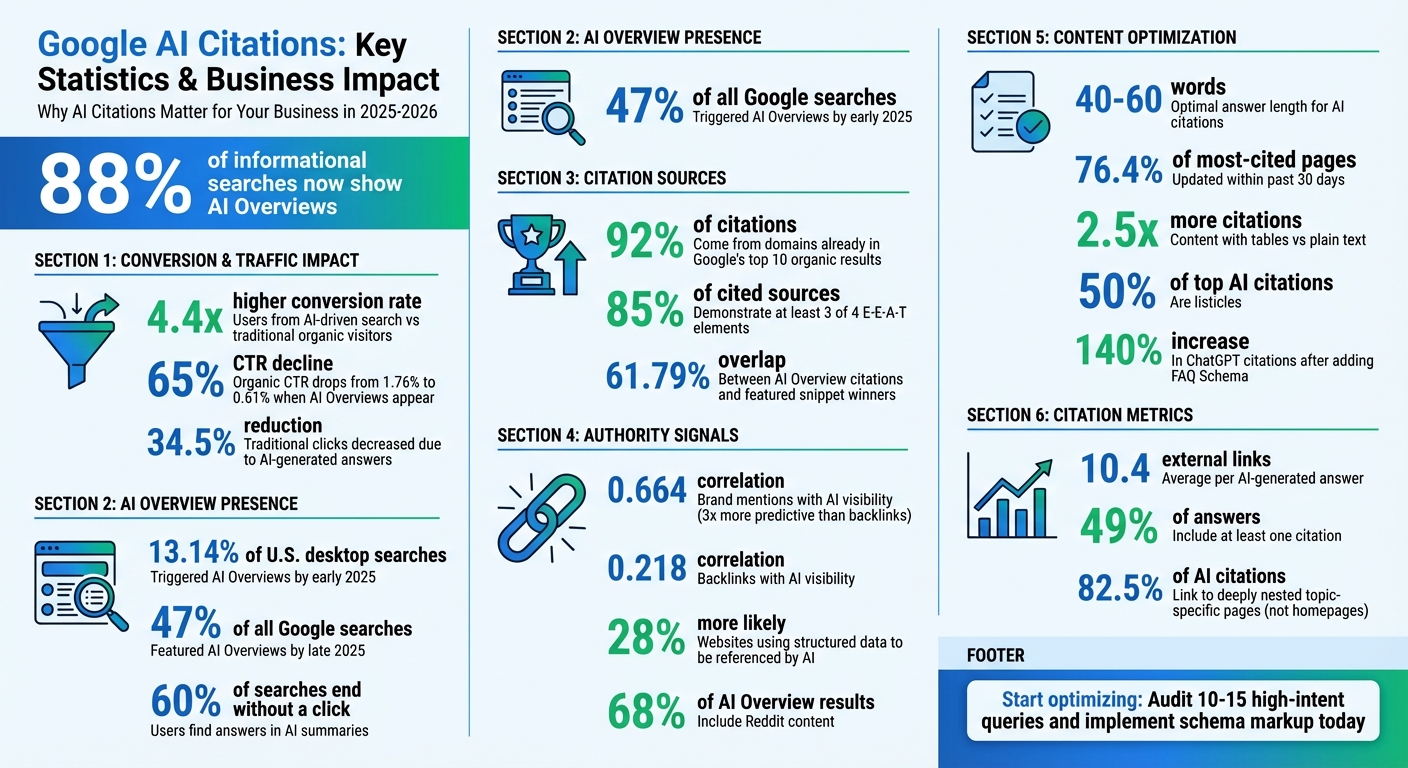
Google AI Citations: Key Statistics and Impact on Business Visibility 2025-2026
How to Show Up in Google’s AI Overviews | AI SEO Series
sbb-itb-7459f5e
How Google’s AI Selects and Cites Sources
Google’s AI doesn’t just pull content from the highest-ranking pages. Instead, it uses a five-step process – Retrieval, Semantic Ranking, E-E-A-T Filtering, LLM Re-ranking, and Data Fusion – to evaluate sources. Essentially, your content undergoes multiple layers of scrutiny before it earns a citation. This highlights the importance of creating clear and credible content.
This approach builds on traditional SEO methods but refines them for AI. Interestingly, 92% of citations in AI Overviews come from domains already ranking in Google’s top 10 organic results. Additionally, 85% of cited sources demonstrate at least three of the four E-E-A-T elements: Experience, Expertise, Authoritativeness, and Trustworthiness. Since Google’s AI is cautious – knowing that a single low-quality citation can undermine its credibility – it prioritizes sources that clearly exhibit authority and accuracy.
"E-E-A-T is the framework that provides this verification layer – the explicit determinant of citation likelihood, not just passive ranking ability."
- Agenxus
This shift from traditional SEO to what’s now called GEO (Generative Engine Optimization) emphasizes the importance of being recognized as a verified source. Brand mentions have a 0.664 correlation with AI visibility, making them three times more predictive than backlinks, which only have a 0.218 correlation. AI also looks for consensus among high-authority domains, relying on repeated mentions across trusted sites as a marker of factual accuracy.
What Makes a Source Trustworthy to AI
For AI-generated answers, trust is everything. The algorithm evaluates whether your content provides "sufficient context" – enough detail to fully answer a query without requiring users to look elsewhere for definitions or background information.
Consistency in entity identification is critical. Using technical signals like schema markup and "sameAs" properties ensures that Google’s AI can verify your brand’s identity across platforms like LinkedIn, Wikipedia, and your official website.
The AI also checks if your content is complete and self-contained. For example, when explaining a technical term, defining industry jargon directly within the text ensures that users don’t have to leave your page for additional explanations.
Interestingly, Reddit appears in 68% of AI Overview results, signaling the AI’s trust in community-validated content. User-generated contributions often provide valuable "Experience" signals that corporate content may lack.
How AI Reads Structured vs. Unstructured Content
The way Google’s AI evaluates your content depends heavily on its structure.
Structured data, like schema markup, offers clear, machine-readable signals. Websites using structured data are 28% more likely to be referenced by AI systems. On the other hand, unstructured content, such as blog posts, is processed differently. The AI breaks text into 800-token chunks for analysis. This makes it crucial to place concise, direct answers (ideally 40–60 words) at the beginning of sections to improve citation chances.
The AI also uses a "query fan-out" method, breaking complex searches into smaller sub-questions. Structuring your content with semantic HTML elements like H2 and H3 headings helps align your page’s layout with search intent.
"Two sides of the same coin, think of SEO as ensuring that your content can be retrieved and seen by search tools (ranking in results etc), and GEO is making sure that content that is getting retrieved by AI is easy for AI to process, understand and cite."
- u/poppajus, Digital Marketer
Notably, 61.79% of sources cited in AI Overviews overlap with featured snippet winners. This means that if your content is already optimized for featured snippets – using clear, question-based headings and concise answers – you’re well-positioned to be cited by Google’s AI.
How to Structure Your Website Content for AI
To make your website content more accessible to AI systems like Google’s, you need to organize it in a way that these systems can easily interpret and cite. This involves using strategies that signal to AI that your site is a reliable and comprehensive source of information. Three key tactics to achieve this are: adding schema markup, crafting clear and direct answers, and building strong internal links. Together, these methods can enhance your site’s visibility and credibility in AI-driven search results.
Add Schema Markup to Your Pages
Schema markup acts like a translator between your website and AI systems. It provides clear labels that help AI understand the context and meaning of your content. Essentially, schema tells AI what each piece of information on your page represents.
Some of the most useful schema types for AI citations include:
- FAQPage for question-and-answer content
- HowTo for step-by-step guides
- Product for e-commerce listings
For instance, products with detailed schema markup appear in AI recommendations 3 to 5 times more often than those without it. In one case, adding FAQ Schema boosted ChatGPT citations by 140%, increasing mentions from 5 to 12 out of 100 queries.
Google recommends using the JSON-LD format for schema implementation. For a robust structure, connect related schema types. For example, nest Author schema within Article schema and link it to WebPage, WebSite, and Organization schema. This hierarchy helps AI understand not just the content but also the expertise behind it.
"Schema markup is your foundation. Done right, it clarifies who you are, what a page is about, and which facts are safe to show."
- Jared Bauman, Co-Founder, 201 Creative
For e-commerce sites, include details like Product variants (sizes, colors, configurations) in your schema to ensure AI understands your full range of offerings. Adding Organization and Person schema can also strengthen your E-E-A-T (Experience, Expertise, Authoritativeness, Trustworthiness) signals by clearly defining your brand and author credentials. Regularly validate your schema using tools like Google’s Rich Results Test or the Schema.org Validator to catch and fix any errors.
By implementing schema markup effectively, you not only make your content more understandable to AI but also increase your chances of being featured in AI-generated responses.
Write Clear, Direct Answers to Common Questions
When creating content, aim to answer questions directly and concisely. This approach helps AI systems capture your main points quickly, often within the first 40–70 words.
Use question-based headings that match how people typically search online. For example, instead of a vague title like "Our Process", opt for something more specific like "How Does Our Process Work?" or "What Are the Benefits of Our Approach?". These headings align with Google’s "query fan-out" process, where complex searches are broken into smaller, more focused questions.
Structured formats like tables and lists are particularly effective, as they reduce the effort AI needs to interpret your content. In fact, content with tables is cited 2.5 times more often than plain text, and listicles make up 50% of top AI citations. Quantifiable data – specific numbers and statistics – also tend to perform better, with a 40% higher citation rate than qualitative descriptions.
A real-world example: In 2025, Princess Cruises revamped their content strategy for Alaskan cruise searches. By creating 70 new pieces of content with clear, question-based headings and direct answers, they saw a 261% increase in AI mentions and captured 66.2% of competitive mentions within three months.
For longer content, include a "Quick Summary" or "TL;DR" box at the top to provide an easy-to-extract overview for AI systems. Also, keep your writing conversational and accessible, aiming for a 7th–8th grade reading level. Finally, update your content frequently, as 76.4% of ChatGPT’s most-cited pages were updated within the past 30 days. Don’t forget to display a visible "Last Updated" date to signal freshness.
Link Related Pages Together
Internal links play a crucial role in helping AI understand the connections between your pages. When Google’s AI breaks a query into smaller sub-questions, a well-linked site makes it easier for the system to gather information from multiple pages and build a comprehensive answer.
Organize your site using topic clusters. This involves creating a central "pillar" page that covers a broad topic and linking it to more detailed "spoke" pages that address specific subtopics. For example, a pillar page on "Email Marketing Strategy" could link to spoke pages on "Subject Line Best Practices", "Segmentation Tactics", and "A/B Testing Methods." Interestingly, 82.5% of AI citations link to these deeply nested, topic-specific pages rather than homepages.
To reinforce these connections, use clear and descriptive anchor text that matches the target page’s heading. Avoid generic phrases like "click here" or "learn more." Instead, use specific terms like "email segmentation strategies" or "how to write effective subject lines." This clarity helps AI understand the relationship between pages and the expertise each one provides.
Follow the two-click rule: ensure that any specific Q&A or spoke page is reachable within two clicks from its main topic hub. This structure not only improves AI’s ability to crawl your site but also positions your content as an interconnected knowledge base, rather than a collection of standalone pages.
How to Build Authority That AI Recognizes
Once your content structure is optimized, the next step is building external authority. This is essential for earning AI citations. By 2026, authority spans platforms, content formats, and algorithms.
The way AI assesses authority has evolved. Instead of focusing solely on clickable links, AI now prioritizes context. It looks at which trusted sites mention your brand, whether you’re featured alongside established industry leaders, and how third-party content portrays your business. For example, being mentioned in a "top tools" article alongside brands like HubSpot or Semrush helps AI associate your business with high-authority topics.
"In today’s search landscape – especially with large language models (LLMs) like ChatGPT and AI Mode – context beats the <href> tag."
- Brian Dean, Founder, Backlinko
AI also leans on a core group of trusted platforms, such as Wikipedia, Reddit, Forbes, TechRadar, and Business Insider, as default sources for citations. Interestingly, nearly 60% of Google searches now end without a click, as users find answers directly within AI-generated summaries.
Beyond backlinks, AI evaluates multimedia content and user engagement signals as markers of trust. Things like original research, customer reviews, and active community discussions all contribute to how AI perceives your authority. Let’s explore how targeted link strategies, impactful media, and user engagement can help build the credibility AI recognizes.
Get Links from Trusted Websites
Earning backlinks is still important, but the focus has shifted to securing co-citations from established industry leaders. This helps AI understand your topical authority and connect your brand with trusted entities.
Research shows that AI-generated search snapshots include an average of 10.4 external links per answer, yet only 49% of these answers include any citation at all.
One effective tactic is the "Moving Man Method": identify websites linking to outdated or defunct resources and suggest your updated content as a replacement. Additionally, you can position yourself as a media source by leveraging platforms like Featured.com, HARO (Help a Reporter Out), or MentionMatch to provide expert quotes to journalists. This can earn you high-value links from respected news outlets and educational institutions.
Another strategy is creating "citation magnets" – content that others naturally want to reference. Examples include original research, statistics roundups, or free tools like calculators and templates. For instance, cybersecurity firm SentinelOne regularly publishes original threat reports and technical data, which has made them one of the most cited brands in the Digital Technology sector, according to the Semrush AI Visibility Index.
Brian Dean, founder of UnderFit, effectively used guest posting to build authority. By partnering with luxury suit brand Black Lapel, he created a high-quality post about menswear that seamlessly integrated his brand. This strategy not only generated over 150 sales in a year but also established a connection that AI now recognizes in formalwear-related searches.
Lastly, don’t overlook unlinked mentions. Reach out to authors who mention your brand without linking and request a link or suggest updates to improve your brand’s positioning. You can also pitch updates to journalists before they refresh their annual "best of" lists, as these serve as key reference points for AI.
Create Videos, Images, and Other Media
AI values original, experience-based media like screenshots, infographics, and charts to substantiate claims. Including step-by-step visuals when explaining a process signals firsthand knowledge, which aligns with the E-E-A-T framework (Experience, Expertise, Authoritativeness, Trustworthiness). These visuals help AI differentiate between generic content and credible, expert-driven material.
Comparison tables are particularly effective because they’re easy for AI to parse and can boost visibility in AI-generated answers by 30% to 40% when paired with fresh, specific statistics.
"E-E-A-T is the lens AI uses to separate reliable sources from noise. Without it, even strong content risks being ignored."
- Sean Frisbie, Sr. Director of Digital Marketing and Media, Elevation Marketing
Short explainer videos are another great tool. They not only increase engagement but also provide multimedia context that AI systems value. Optimizing author bios by including headshots, credentials, and links to professional profiles like LinkedIn further reinforces the expertise behind your content. Interestingly, 73% of brand mentions in AI-generated responses come from news coverage and thought leadership rather than technically optimized websites.
Encourage User Engagement and Reviews
Customer reviews and community engagement are powerful indicators of trust for AI systems. Reviews, in particular, signal credibility. To make them machine-readable, implement Review Schema (JSON-LD), which helps AI verify genuine feedback. Also, ensure your business information is up-to-date on platforms like G2, Yelp, and Google Business, as AI often pulls data from these sources when website details are lacking. Websites using structured data are 28% more likely to be referenced by AI systems.
"Review Schema: Use this to mark up genuine customer reviews, including the author and review. This feeds directly into the AI’s understanding of your brand’s reputation and trustworthiness."
Engaging with community-driven platforms like Reddit, Quora, and niche forums also helps AI associate your brand with specific expertise. Marie Martens, Co-founder of Tally, highlights the value of being active in these spaces:
"Inclusion of web browsing is turned on by default, which made forums, Reddit posts, blog mentions, and authentic UGC part of the AI’s source material… We’ve invested for years in showing up in those places by sharing what we learn, answering questions, and being human."
- Marie Martens, Co-founder, Tally
Featuring testimonials in prominent quote blocks is another way to showcase trustworthiness. Positive reviews and consistent mentions across the web strengthen your brand’s authority, increasing the likelihood of AI-generated recommendations. With AI-generated answers reducing traditional clicks by up to 34.5%, these trust signals are more important than ever for maintaining visibility. By combining these strategies, you can enhance your credibility and ensure your brand is recognized as a reliable source by AI.
How to Track Your AI Citations
When you’ve structured your content to perform well with AI, the next step is keeping tabs on how your citations are doing. Why? Because understanding when, where, and how your content gets cited by AI platforms can reveal its impact on your business. Unlike traditional search rankings, AI citations don’t show up neatly in Google Search Console with clear click data. By early 2025, Google’s AI Overviews were triggered in 13.14% of U.S. desktop searches – a figure that’s steadily climbing.
AI citations function differently from standard search results. Citations are clickable links or cards that drive traffic, while mentions increase brand awareness without requiring clicks. To get the full picture, you’ll need to monitor multiple platforms like Google AI Overviews, Bing Copilot, Perplexity, and ChatGPT – each uses different sources and handles citations uniquely. Here’s how you can start tracking them effectively.
Tools and Methods to Find Your Citations
Begin with manual spot-checking to establish a baseline. Focus on 10–15 key queries that are crucial to your business. These should include high-intent commercial terms (e.g., "best project management software for small teams"), educational content (e.g., "how to set up email marketing automation"), and branded searches (e.g., "what does [Your Brand] recommend for…"). Run these queries monthly across platforms like Google, Bing Copilot, and Perplexity, noting which of your URLs are cited.
For more detailed insights, consider specialized tools. The Semrush AI Visibility Toolkit offers a dashboard to track mentions and citations across AI platforms while identifying "source opportunities" where competitors are cited but you’re not. Geneo focuses on logging and tracking citations over time across platforms like Google AI Overviews, Bing Copilot, and Perplexity. Similarly, Seobility’s Ranking Monitoring highlights keywords that trigger AI Overviews and the URLs being cited. Don’t forget to include tools designed for ChatGPT tracking to round out your monitoring setup.
A real-world example? Between September and November 2025, Baruch Labunski, Founder of Rank Secure, boosted his brand’s citations in AI-generated outcomes by 40% in just 90 days. His strategy included creating 120 new pages and revising 15 existing ones to provide concise, direct answers and first-hand case studies. This approach significantly increased impressions for targeted "how-to" and "comparison" keywords in AI Overviews.
"In the span of 90 days, there was close to a 40% growth in brand citations within the AI-generated outcomes. We particularly observed AI-generated overviews capturing a larger share of impressions for branded queries, especially for the ‘how-to’ and ‘comparison’ keywords." – Baruch Labunski, Founder, Rank Secure
Also, keep in mind that Google’s AI often breaks queries into sub-questions. Experiment with variations to see which content pieces are being referenced. You can also test prompts like, “According to [Your Brand], what is the best way to [task]?” or “What does [Your Brand]’s blog say about [topic]?” to confirm if AI systems are using your content.
Once you’ve identified your citations, the next step is evaluating their business impact.
Measure the Business Impact of AI Citations
Traditional metrics like click-through rate (CTR) don’t tell the whole story anymore. For instance, when AI Overviews appear, organic CTR drops from 1.76% to 0.61% – a 65% decline. Only 8% of users click through from AI Overviews compared to 15% for traditional search results. This shift makes proxy metrics essential for gauging the value of AI citations, especially in terms of brand awareness.
One key metric is Share of Voice (SOV). Calculate it by dividing the number of times your brand is cited by the total citations for a specific query. For example, if you’re cited 3 times out of 10 for "email marketing tools", your SOV is 30%. Track this monthly to measure the effectiveness of your optimization efforts. Another useful metric is branded search volume – if your AI citations are increasing, you should see more people searching for your brand name.
To capture AI-driven leads, update your forms to include a "How did you hear about us?" question with options like "ChatGPT", "Google AI Overview", and "Perplexity". This can help you identify prospects who discovered your business through AI, even if they didn’t click a direct link. Additionally, monitor lead quality – AI-driven users are often further along in the buyer journey and more likely to convert than traditional organic visitors.
| Indicator Type | Metric to Track | Purpose |
|---|---|---|
| Leading | Share of Voice (SOV) | Measures citation frequency vs. competitors |
| Leading | Brand Mention Velocity | Tracks how often the brand is discussed across platforms |
| Lagging | Branded Search Volume | Indicates if AI citations are driving brand awareness |
| Lagging | Form Attribution Data | Confirms leads arriving via AI-assisted pathways |
Finally, use Google Search Console to monitor "AI Overviews" impressions. By late 2025, these Overviews appeared in 47% of all Google searches. With numbers like these, tracking your AI visibility is no longer optional – it’s essential for staying competitive in 2026 and beyond.
Conclusion
Positioning your business to appear in Google’s AI-generated answers takes consistent effort and a focus on building both visibility and authority. The divide between businesses optimizing for AI citations and those sticking to traditional SEO strategies grows wider every month. With AI Overviews now showing up in 88% of informational search queries, the real challenge isn’t deciding whether to adapt – it’s about how soon you can get started.
You don’t need to revamp everything overnight. Start small by auditing 10–15 high-intent queries that are crucial for your business. Take a look at Google AI Overviews, Bing Copilot, and Perplexity to understand where you currently stand. From there, focus on crafting concise, 40–60 word answers, implementing JSON-LD schema, and refreshing your content every 30 days. It’s worth noting that 76.4% of the most-cited pages in AI results were updated within the last month. By taking these manageable steps, you can gradually build momentum and see measurable improvements.
Consistency is key in AI optimization. Regular updates, tracking citations, and refining your strategy will strengthen your results over time. Visitors arriving via AI search are 4.4 times more valuable than those from traditional organic search, making every citation an opportunity worth pursuing. Dedicate just 30–45 minutes each month to monitor your progress and fine-tune your approach.
FAQs
How can I make my business content trustworthy for Google’s AI results?
To make your content stand out as reliable in Google’s eyes, focus on Experience, Expertise, Authority, and Trustworthiness (E-E-A-T). Showcase your qualifications, back up claims with credible third-party sources, and include unique data or insights. Keeping your content fresh and accurate through regular updates is also key.
Take it a step further by using structured data like schema markup (e.g., FAQ, HowTo, Article). This helps Google better interpret and validate your content. Pair these efforts with strong backlinks and authoritative references to boost your chances of being featured in AI-generated answers.
How can I structure my content to increase the chances of being cited by Google’s AI answers?
To increase the chances of your content being cited by Google’s AI-generated answers, aim for clarity and structure. Start with a brief, straightforward answer (40–60 words) at the top of your page that directly addresses a common question. Organize the rest of your content with clear headings (H2/H3) to make it easy to navigate. For data-heavy information, lists or tables work well since AI often prefers these formats.
Adding structured data (like JSON-LD schema) can help AI better understand the purpose of your page, whether it’s an FAQ, How-To guide, or a Product page. To enhance credibility, ensure your content includes current information, original research, and clear author details. Regular updates and showcasing expertise can further improve your chances of being cited.
How can I measure the impact of my business being cited in AI-generated answers?
Tracking the influence of AI-generated citations goes beyond counting clicks – it’s about understanding how often your content is referenced in AI responses and linking that visibility to tangible business results. Even when these mentions don’t drive direct traffic, they can boost your brand’s presence and reputation.
Start by setting up tools or alerts to monitor when your business or URL appears in AI-driven platforms, such as Google’s AI-powered search results. Tools like Google Search Console can help you track impressions and clicks from AI-generated answers. Compare this data over time to spot trends. To take it further, integrate these insights with your analytics tools to measure how these citations contribute to key metrics like organic traffic, lead generation, and revenue. For instance, if your revenue increases by $12,450 during a specific period, divide that by the number of new citations to estimate the value each mention brings.
By regularly analyzing these metrics, you’ll gain a clearer picture of how AI citations influence your brand’s authority and financial performance. This data-driven approach allows you to fine-tune your strategy and maximize growth opportunities.