Short Answer: Yes, you need a website even if you have social media. Here’s why:
- Trust and Credibility: 84% of consumers trust businesses with a website more than those relying only on social media.
- Ownership and Control: Social media platforms can change algorithms, restrict reach, or even ban accounts. A website is fully yours and immune to these risks.
- Search Visibility: Websites rank better on Google, helping customers find you when searching for products or services.
- Professional Image: A website with a custom domain and branded email shows you’re serious about your business.
Key Takeaway: Social media is great for quick engagement and discovery, but it’s unpredictable. A website is your stable, long-term foundation for growth. Together, they create a strong online presence.
Are Websites Dead? What Small Businesses Need Now
What Social Media Does Well for Small Businesses
Social media platforms are a game-changer for small businesses, offering instant visibility in ways traditional websites can’t. With over 30 million small businesses using social media as part of their marketing strategy, it’s clear these platforms offer unique opportunities to connect with audiences.
Quick Audience Reach and Engagement
Think of social media as a discovery tool – a single post has the potential to reach thousands, sometimes even millions, in no time. Short-form content like TikTok videos or Instagram Reels can go viral, introducing your brand to entirely new audiences. Plus, platforms like Facebook and Instagram allow you to target specific demographics, such as age, location, and even income level, making it easier to connect with your ideal customers.
Take the story of Danni Eickenhorst, co-owner of Steve’s Hot Dogs in St. Louis, for example. In 2020, she used a Facebook event to promote a "Six Feet ApartY." By collaborating with local neighborhood associations and sharing the event in Facebook Groups and Nextdoor, her post reached 28,100 people. The results? The restaurant gained 150 new Facebook page likes, 75 new Instagram followers, and achieved sales that were three times higher than a typical Saturday.
Low-Cost Marketing Options
One of the best things about social media? It’s free to get started. You can build an audience organically by sharing "edutainment" content – posts that both educate and entertain. This type of content is highly effective, with 66% of social media users saying they find it the most engaging.
If you want to take it further, paid advertising is surprisingly affordable, starting at just a few dollars per day. These low-cost campaigns make social media an excellent option for businesses working with limited budgets. On top of that, you can tap into user-generated content by sharing photos, reviews, or testimonials from your customers. Not only is this free, but it also builds trust with your audience.
"Social media is our second-biggest driver of sales. Most customers say they discover us on Instagram and didn’t realize we had a content site or a store until we promoted them on social." – Laura Moss, Cofounder, Adventure Cats
These budget-friendly strategies open the door to even more meaningful, real-time customer interactions.
Real-Time Customer Interaction
Social media isn’t just about posting; it’s about connecting in real-time. Whether through comments, direct messages, or live chats, you can respond to customers quickly and personally. This level of interaction builds trust and makes your brand more approachable. Many customers actually prefer reaching out via DMs instead of making phone calls, especially when they need quick answers before making a purchase.
"Social media allows them to write a direct message (DM) to ask questions and get the details they need without the anxiety of a phone call." – Sasha Andrievskaya, Social Media Manager, WebWave
Why Your Business Needs a Website for Long-Term Growth
Social media might grab attention fast, but a website is what gives your business the foundation it needs to grow steadily over time. Think of social media as a spark – it’s quick and bright – but a website is the steady flame that keeps your business thriving.
Complete Ownership and Control
Relying only on social media can leave your business at the mercy of unexpected algorithm changes or account issues. Imagine this: a sudden tweak in the platform’s rules could cut your reach by 70% overnight. A website, on the other hand, is entirely yours. You decide how it looks, what it says, and how visitors interact with it. Unlike fleeting social media posts, blog content on your website continues to attract traffic for months – or even years.
"Social-only is like putting signage in front of a mall without a shop; people might stumble in, but it’s far harder to build lasting momentum." – Klutch Growth
This level of control not only safeguards your business but also projects a professional image that builds confidence in your audience.
Building Trust and Looking Professional
A well-designed website isn’t just about control – it’s about trust. Here’s a reality check: 84% of consumers think a business with a website is more credible than one that only relies on social media. And when 81% of potential customers research online before making a purchase, they expect to find a professional website. Features like a custom domain (yourbusiness.com) and a branded email (name@yourbusiness.com) show that you’re serious about your business and its reputation.
"In our digital age, not having a website for your business is grounds for suspicion, and you will not be able to convert as many sales as you would if you had a more stable digital presence." – Liz Riggleman, Arrowlift
SEO and Getting Found in Search Results
A website isn’t just about looking professional – it’s also about being discoverable. Social media profiles rarely rank well on Google, but a well-optimized website can put your business front and center. Every page – whether it’s a blog post, a service description, or a product listing – adds to your SEO strength over time. This means people searching for solutions you offer can find you, even if they’ve never heard of your business before. With over 90% of Americans online, and most starting their search on Google, a strong website ensures you’re not invisible.
"You can go from being an invisible plumber in Cleveland… to a plumber in Cleveland who shows up whenever someone nearby searches for how to unclog a drain." – Elliot Brown, OnPay
Website vs. Social Media: Feature Comparison
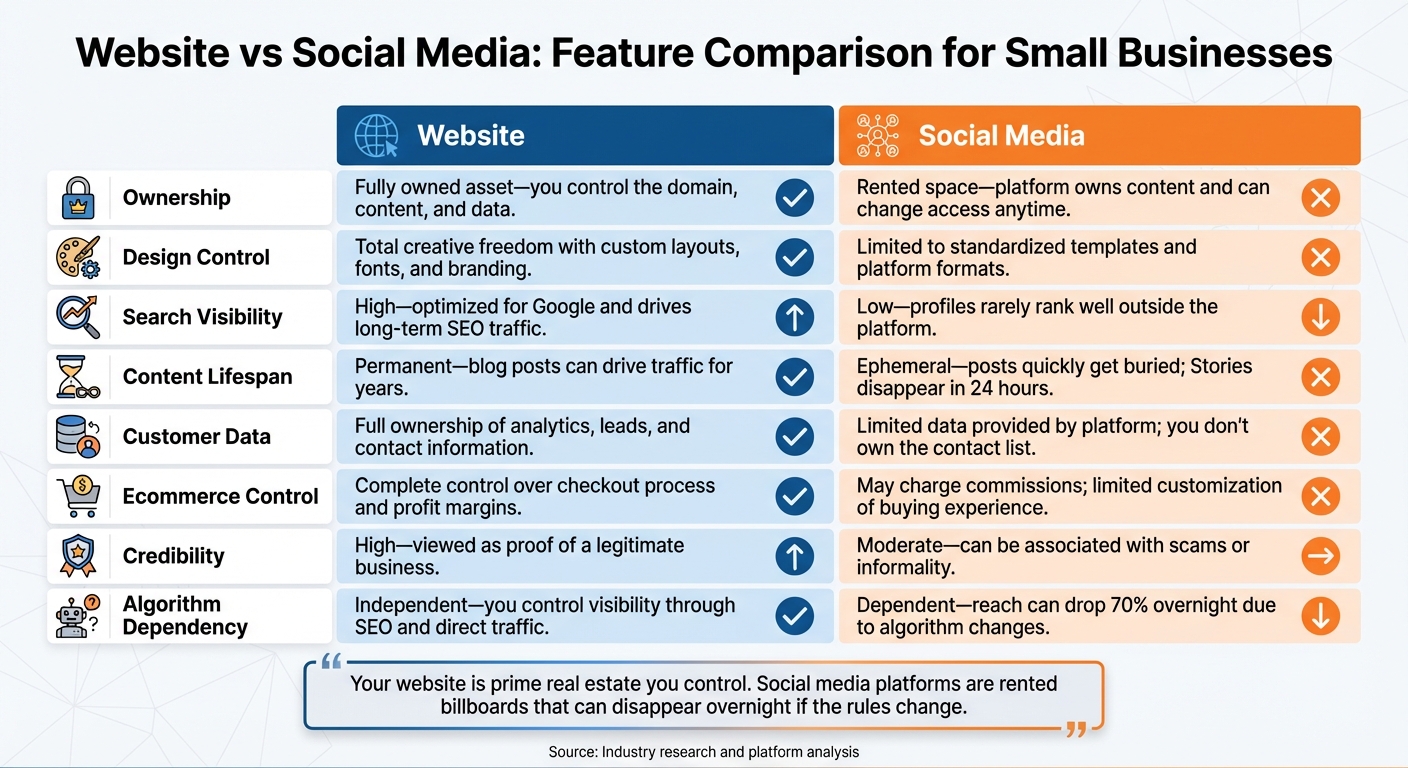
Website vs Social Media: Feature Comparison for Small Businesses
When deciding where to focus your time and resources – your website or social media – it’s important to understand the unique role each plays in your business strategy.
The primary distinction boils down to ownership. Think of a website as owning your home – you have full control over its design, content, and functionality. Social media, on the other hand, is more like renting an apartment – the platform dictates the rules. Nicholas Carr, former Executive Editor at Harvard Business Review, explains it well: "Digital sharecropping… refers to situations where a large platform owner effectively owns all the content that users create".
"Your website is prime real estate you control. Social media platforms are rented billboards that can disappear overnight if the rules change."
- Oluwadunmola Adefioye, Internet Marketer, Klutch Growth
To help you see the differences clearly, here’s a side-by-side comparison of key features and how they impact your business strategy.
Feature Comparison Table
| Feature | Website | Social Media |
|---|---|---|
| Ownership | Fully owned asset – you control the domain, content, and data | Rented space – platform owns content and can change access anytime |
| Design Control | Total creative freedom with custom layouts, fonts, and branding | Limited to standardized templates and platform formats |
| Search Visibility | High – optimized for Google and drives long-term SEO traffic | Low – profiles rarely rank well outside the platform |
| Content Lifespan | Permanent – blog posts can drive traffic for years | Ephemeral – posts quickly get buried; Stories disappear in 24 hours |
| Customer Data | Full ownership of analytics, leads, and contact information | Limited data provided by platform; you don’t own the contact list |
| Ecommerce Control | Complete control over checkout process and profit margins | May charge commissions; limited customization of buying experience |
| Credibility | High – viewed as proof of a legitimate business | Moderate – can be associated with scams or informality |
| Algorithm Dependency | Independent – you control visibility through SEO and direct traffic | Dependent – reach can drop 70% overnight due to algorithm changes |
This comparison highlights how websites and social media serve different purposes. While websites provide a stable, long-term foundation for your brand, social media offers a dynamic way to engage with audiences. Combining both can create a balanced and effective digital strategy.
sbb-itb-7459f5e
How Turbify Helps Small Businesses Build Better Websites
Once you understand the importance of having a website, the next step is figuring out how to create one that truly works. That’s where Turbify steps in, offering a comprehensive set of tools to help small businesses establish an effective online presence.
Turbify’s Website Tools
Turbify equips you with everything you need to get started. From domain registration – your permanent online address – to 24/7 web hosting and scalable WordPress hosting, they’ve got the essentials covered. Plus, you can take advantage of professional website design services that ensure your site makes an immediate impact.
Here’s why design matters: 75% of consumers base a business’s credibility on its website design. When a potential customer visits your site, you only have a few seconds to leave a positive impression. A clean, professional design tells visitors that your business is trustworthy and worth their attention.
These tools provide a strong foundation for building a credible and expandable online presence that works in harmony with your social media efforts.
Tools for Ecommerce and Local Businesses
If you’re diving into ecommerce, Turbify offers WooCommerce hosting tailored for online sales. Features like secure payment processing and integrated inventory management make handling transactions seamless.
Consider this: 88% of businesses report that having a website makes it easier for customers to find them, and 81% experience growth as a result. Turbify’s tools are designed to support both local businesses expanding online and fully digital ventures. With these features, you can manage your customer experience and protect your profit margins – all from one platform.
Using Social Media and Websites Together for Better Results
Combining the power of social media with the functionality of a website can amplify your online presence. While social media helps attract attention and introduces new audiences to your business, your Turbify website acts as the place where interest turns into action – whether that’s making a purchase, booking a service, or building lasting customer relationships. This strategy builds on the earlier discussion of how each platform has its strengths and works better together.
Building a Connected Online Presence
To create a seamless online experience, make sure your website and social media accounts work hand in hand. Start by cross-linking: include your website URL in all your social media bios, and add social media icons to your Turbify website’s footer so visitors can easily follow you. This two-way link ensures that no matter where someone finds you, they can dive deeper into your business.
Consistency is key. Use the same logo, colors, and tone of voice across all platforms to build a recognizable brand. For your social media content, follow the 80/20 rule: dedicate 80% of your posts to engaging, educating, or entertaining your audience, and only 20% to promoting your products or services. This mix helps build trust and keeps your brand approachable.
Turning Social Media Followers into Website Customers
While 43% of internet users discover new products or services through social media, discovery alone isn’t enough to grow your business. Every post should include a clear call-to-action, such as “Shop Now,” “Book an Appointment,” or “Get a Quote,” to guide followers to your website. Pair these calls-to-action with lifestyle photos to create an emotional connection with your audience.
"Social media is our second-biggest driver of sales. Most customers say they discover us on Instagram and didn’t realize we had a content site or a store until we promoted them on social." – Laura Moss, Cofounder, Adventure Cats
Take things further by adding an email capture form to your website. This allows you to turn social media visitors into subscribers, giving you the chance to nurture those relationships over time. Tools like Google Analytics can help you track which social platforms are driving the most valuable traffic, enabling you to refine your strategy. And don’t underestimate the power of engagement – responding to comments and messages promptly builds trust and encourages people to visit your website.
Conclusion: You Need Both Social Media and a Website
To build a solid, lasting business, you need both social media and a website. Social media is great for grabbing attention, fostering community, and connecting with customers in real time. However, relying solely on platforms controlled by others leaves your business vulnerable. That’s where your website comes in – it’s the one online space you fully own.
Your website plays a crucial role in establishing trust, capturing leads, and improving search visibility. On the other hand, social media serves as the channel to distribute content and drive traffic back to your site. Together, they create a powerful synergy.
"Think of social media as the attention grabber and a website as the closer." – Agency Partner Interactive
The most successful small businesses treat their website as the central hub, with social media acting as the spokes of their digital strategy. This approach not only safeguards your business from unforeseen platform changes but also consolidates your customer data in one place. It’s about creating a balanced and resilient online presence.
Turbify makes it easy to build a professional website that works seamlessly with your social media efforts. With tools for domain registration, WordPress hosting, WooCommerce integration, and business email, Turbify provides everything you need to create a cohesive digital presence. Whether you’re selling products, booking appointments, or growing your brand, Turbify empowers you to break free from social media’s limitations and achieve long-term success.
FAQs
Why is having a website more dependable than just using social media for my business?
A website serves as a reliable, fully-controlled online space for your business. Unlike social media platforms – which can shift policies, tweak algorithms, or even disappear – your website stays constant. You have full authority over its design, content, and how you handle customer data, making it a dependable cornerstone of your online presence.
It also plays a key role in building trust and credibility with your audience. A custom domain and a thoughtfully designed site convey professionalism and authenticity. Plus, features like eCommerce tools, blogs, and contact forms offer capabilities that go far beyond what social media platforms can provide. In the end, your website isn’t just a tool – it’s an adaptable asset that evolves alongside your business, supporting its growth over time.
How does having a website improve my business’s visibility compared to just using social media?
A website offers your business a big boost in search visibility because it can be indexed by search engines like Google. By applying SEO techniques – like targeting the right keywords, publishing quality content, and earning backlinks – you can drive more organic traffic and climb higher in search results. In contrast, social media posts are limited to the platform’s internal search, which doesn’t provide the same reach or visibility.
A website also lets you craft a tailored and professional online presence that builds trust with potential customers. Unlike social media, where you’re restricted by the platform’s design and rules, a website gives you complete control over your branding and content. This freedom allows your business to stand out and grow in a way that’s entirely on your terms.
Why should I have a website if I already use social media for my business?
Having a website in addition to your social media presence gives your business a stronger foundation to grow and connect with your audience. Social media is fantastic for interaction and visibility, but a website lets you take things further by capturing leads, analyzing visitor behavior, and creating a personalized experience. For instance, tools like email sign-ups and analytics can help you better understand your audience and build stronger connections.
A website also adds trust and professionalism to your brand. Features like a custom domain and secure browsing reassure visitors and enhance your credibility. Unlike social media platforms – where algorithms and policies can shift without warning – your website is entirely yours. It’s a space where you can fully showcase your brand, offer detailed information about your products or services, and even enable e-commerce for smooth transactions. When combined, a website and social media presence become a powerful duo, helping you reach more people and grow your business steadily.