
Slow hosting can cost you sales. If your pages lag on checkout, booking, or contact forms, your host may be part of the problem – and you can spot it with a few simple checks this week. Below, I’ll show you what to test first, how to tell host issues from site issues, and what to do next if your results point to a bad setup.
If I had to boil the article down to one point, it’s this: don’t guess. Run a short set of checks on the pages that make you money, and let the pattern tell you whether to fix the site, upgrade your plan, or move hosts.
Here’s the fast read.
- Start with the big three: page speed, server response time, and uptime. If your TTFB – time to first byte, or how long the server takes to start replying – is high again and again, that usually points to hosting, not images or plugins.
- Test money pages, not just your homepage. A homepage can look fine while your checkout page crawls on mobile. That’s where lost revenue shows up.
- If uptime is steady and TTFB looks normal, the drag is often inside the site. Think large images, too many scripts, plugin conflicts, or a heavy database query on product filters or cart updates.
- Mobile deserves its own check. More than half of web traffic comes from mobile on many small business sites, so a slow phone experience can hit conversions hard even if desktop looks okay.
- Caching and CDN settings matter. If those are off, your server may be doing the same work over and over. For stores, cart and checkout pages must be excluded from cache the right way.
- Peak-hour testing tells the truth. A site that works at 9:00 a.m. but times out at noon is often hitting hosting limits, not a design problem.
- Use a simple pass / warning / fail list. That keeps you from making random changes and helps you decide where to spend time first.
A few numbers help put this in context. Even a 1-second delay can cut conversions, and short outages during a promo can mean missed orders right away. That’s why I’d focus first on pages tied to action: product pages, checkout, booking forms, and contact forms.
What I like about this piece is that it pushes you toward a clear split:
- If only a few pages are slow, fix the site first.
- If the whole site drags, TTFB stays high, or you see timeouts during busy periods, the host is likely the choke point.
My take: that’s the right way to approach it. Too many owners swap hosts before checking scripts, and too many others keep patching plugins when the server is the problem.
If you use this article as a checklist, do this next:
- Pick your top 3 revenue pages.
- Test them in PageSpeed Insights or GTmetrix.
- Write down TTFB, mobile results, uptime notes, and peak-hour behavior.
- Fix any fail on checkout first.
- Retest before you spend money on a new plan.
That’s the core answer. Hosting can cost you sales, but the fix is not always “switch providers.” Run the seven checks, sort the results by page, and you’ll know whether to clean up the site, change settings, or move to a better hosting plan.
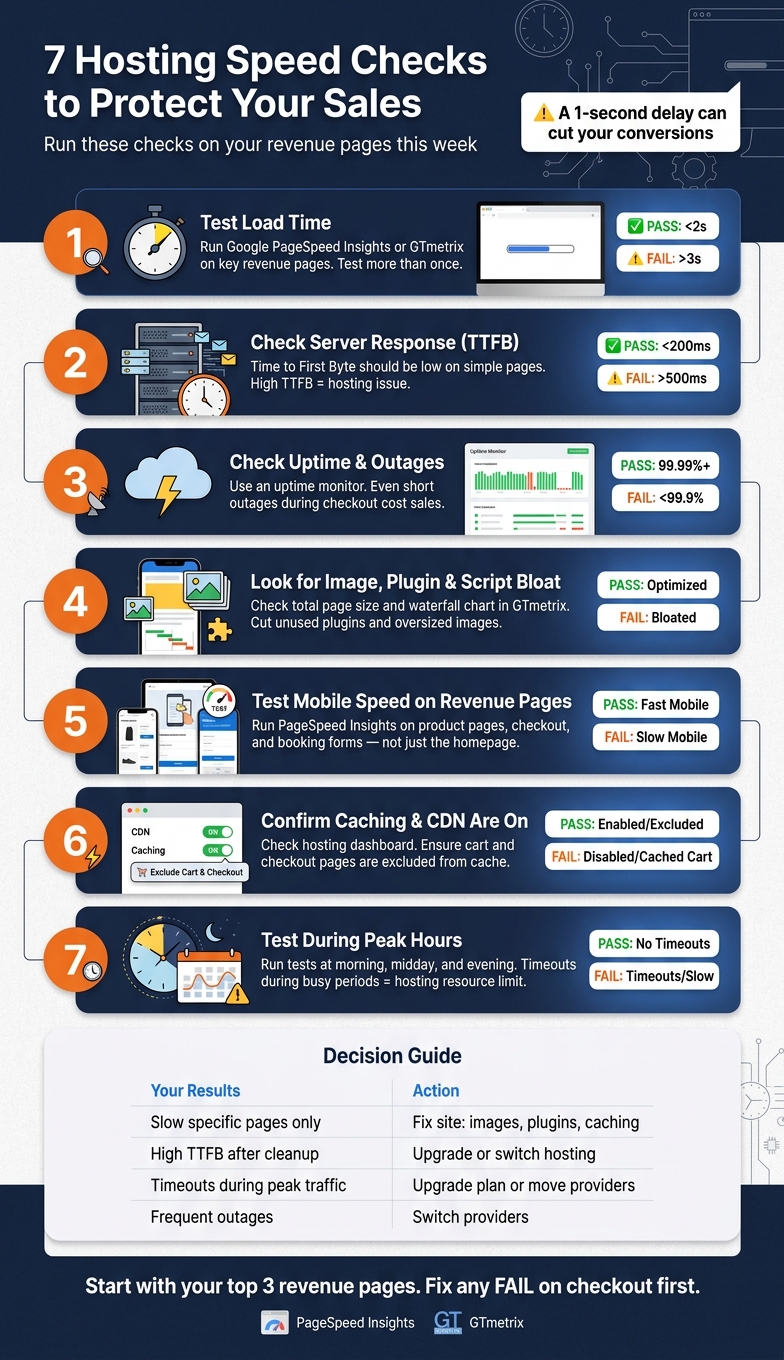
7 Hosting Speed Checks to Protect Your Sales
Does Your Web Host Really Affect Site Speed?
3 Quick Checks to Run First for Obvious Speed Issues
Start with these three checks. They’ll tell you fast whether your hosting is the problem or whether you should look inside the site first.
If even one of these checks goes sideways, that’s a strong clue your hosting needs a closer look.
1. Test Load Time With Google PageSpeed Insights or GTmetrix
Test your key revenue pages in Google PageSpeed Insights or GTmetrix. Run each page more than once, then write down the test location, device, plan, and cache state so you can compare results later.[1]
If the page is slow, look at where the delay begins. When the lag starts at the server, hosting is often the first thing to check.
2. Check Server Response Time (TTFB)
Check TTFB – Time to First Byte, which means how long the server takes to begin sending data. If TTFB is high on a simple page, the problem usually points to the host, not your design.[1]
A simple page matters here because it strips away extra noise. If TTFB looks fine, move on and make sure the site is staying online.
3. Check Uptime and Recent Outages
Use an uptime monitor and compare what you find with your host’s uptime guarantee. Even a short outage during checkout can cost you sales and chip away at trust.[1]
If uptime looks steady, the slowdown is probably coming from inside the site itself. Your next move is to check plugins, images, scripts, or theme issues.
Check What’s Slowing Down the Site Itself
The practical takeaway is simple: if uptime is steady and TTFB – time to first byte, the delay before the server starts sending data – looks normal, the drag is inside your site. That means the problem is usually page weight, plugins, scripts, or database load, not the hosting account.
Use the checks below to tell the difference between site bloat and host-side bottlenecks. That saves you from swapping hosts when the real issue is a 6 MB product page stuffed with scripts.
4. Look for Image, Plugin, and Script Bloat
Start with GTmetrix on your main pages. Check total page size and the waterfall chart – the step-by-step view of what loads and when.
Big page sizes, too many requests, or a pile of scripts are red flags. If the pages that bring in orders, bookings, and leads are heavy, you’ll feel it in slower loads and lower conversion rates.
Common trouble spots include unoptimized images, bloated themes, and plugins or scripts that clash with each other. It’s the digital version of stuffing your trunk with junk and then wondering why the car feels slow.
Cut image file sizes, remove plugins you don’t use, and turn off third-party scripts that don’t help sales or lead generation. If static pages load fast but checkout or product filters crawl, focus on database strain or plugin conflicts.
Then compare that with mobile speed on the pages that make you money.
5. Test Mobile Speed on the Pages That Drive Revenue
Run Google PageSpeed Insights on your product pages, checkout, booking forms, and lead forms. Those are the pages that matter most, so don’t judge the whole site by the homepage.
If the mobile score is much lower than the desktop score on the same page, there’s a good chance you’re losing conversions on phones. A homepage can look fine while checkout drags badly on mobile.
Use the table below to sort what you find:
| Result | What It Means |
|---|---|
| Pass | Fast on mobile and desktop; checkout works smoothly. |
| Warning | Mobile lags or cart updates slow down. |
| Fail | Timeouts, crashes, or failed test payments. |
If mobile results land in Warning or Fail, check caching and CDN next. Caching stores ready-to-serve copies of pages, and a CDN – content delivery network – serves files from locations closer to your visitors.
sbb-itb-7459f5e
Check Whether Your Hosting Setup Is Doing Its Job
If the first five checks point to setup or traffic spikes, shift your attention to the host. When this part is off, your site may be built fine but still feel slow because pages and files are not being delivered well.
That kind of slowdown costs sales. It’s not just about a speed test score.
6. Confirm Caching and CDN Are Turned On
Start by checking whether caching and CDN are on. If they’re off, your host may be making the server do the same work over and over, and that wastes time on every page load.
Log into your hosting dashboard and look for a Caching or CDN section. Turn both on there if they’re available. If your host doesn’t include them, install a caching plugin instead. [1]
For ecommerce sites, use cart- and checkout-safe caching. That means the cache must avoid storing shopping cart and checkout pages the wrong way. If it doesn’t, one shopper can see the wrong cart data or hit checkout problems. Managed WordPress hosts usually set this up for you, while plain shared hosting often needs manual setup. [1]
You can also check whether your CDN is working by looking at your file URLs. If the CDN is active, images, scripts, or other files often load from a CDN address instead of your main domain.
Warning sign: If product images still load from your main domain instead of the CDN, it is not active or configured correctly. [1]
Next step: open a few product pages, inspect the image URLs, and confirm your cache settings exclude cart and checkout pages.
7. Test Performance During Busy Times
Test your site during busy hours, not just when traffic is low. A site that looks fine at 9:00 a.m. can fall apart at noon or during a sale, and that usually points to a hosting resource limit.
Run tests in the morning, midday, and evening. Also test during any promo or flash-sale window.
If load times rise a lot or you start seeing timeout errors during peak traffic, your hosting plan may not have enough resources for those traffic spikes. [1]
| Result | What It Means |
|---|---|
| Pass | Consistent load times across morning, midday, and evening tests. |
| Warning | Noticeable slowdown during peak hours but no errors. |
| Fail | Timeouts, 504 errors, or crashes during busy periods. |
Use what you find to sort the problem into one of two buckets: setup, server capacity, or both. Then compare your peak-hour results with your hosting plan limits and decide whether you need to fix settings, move to a better plan, or do both.
Fix, Upgrade, or Switch? How to Read Your Results
Start by sorting each key page into pass, warning, or fail. That tells you whether you’re dealing with a page problem or a hosting problem.
Look at the pattern, not just one bad result. If only a few pages are slow, the trouble is usually on the site itself. If the whole site drags, your host may be the choke point.
When Small Fixes Are Enough
If your TTFB is low, uptime is steady, and the slowdown only shows up on certain pages, focus on the site first. In plain English, that usually means too many large images, too many plugins, or too much script code loading at once.
A few low-cost fixes can help fast. Compress images, remove plugins you don’t use, and turn on caching – storing ready-made versions of pages so the server does less work each time someone visits.
Make one change at a time, then retest. Watch bounce rate, form completions, and checkout rate after each update. If those numbers improve, your host probably isn’t the main issue.
When Your Host Is Likely the Problem
If TTFB stays high after cleanup, the host is likely the bottleneck. That’s a hosting issue, not a page issue.
You may also see downtime during promotions, timeout errors, or a slow admin area even when traffic is low. Those are strong signs your current setup can’t keep up.
| Your Results | What to Do |
|---|---|
| Healthy TTFB, solid uptime, slow specific pages | Fix site-level issues first: images, plugins, and caching |
| High TTFB even after cleanup | Upgrade your plan or switch hosting |
| Timeouts or crashes during peak traffic | Upgrade your plan or move to a better provider |
| Frequent outages | Switch providers |
Why Small Business Owners Choose Turbify
If you want a host made for non-technical owners, Turbify keeps the basics in one place. You get hosting, domains, email, and ecommerce, plus 25+ years of experience, 24/7 support, daily backups, and free SSL – the security lock icon in the browser bar.
Take your result from the table and use it to map out your 7-day action plan next.
What to Do Next: A 7-Day Action Plan Based on Your Results
Turn your seven checks into a short action list you can use this week. Keep it focused on the pages that bring in sales and leads.
Build a Simple Pass, Warning, or Fail List for Your Key Pages
Start with your money pages: product pages, checkout, and contact forms. For each page, log the result from all seven checks – load time, TTFB, uptime, bloat, mobile speed, caching/CDN, and peak performance – then label each result as pass, warning, or fail based on what you already recorded. [1]
Start with any "fail" marks on your checkout or product pages. Those directly affect conversion rates and customer trust. [1]
A plain spreadsheet works fine here. One row per page, one column per check, and a final status column makes the problem spots easy to see. [1]
Retest After Changes and Decide on Your Next Hosting Step
Fix the pages with failures first, especially checkout and product pages. After each fix, run the same checks again so you can see if the change helped. [1]
If checkout still stalls after cleanup, your hosting is hurting sales. Move to a better plan or switch to a host with stronger checkout speed, caching, and traffic handling. [1]
If TTFB – time to first byte, or how long the server takes to start responding – stays high and checkout still stalls after cleanup, upgrade or switch hosts.
FAQs
How do I know if hosting is the problem?
Watch your site during peak traffic. If the admin dashboard drags, checkout takes too long, product pages feel slow, or the site acts differently from one visit to the next, that’s a warning sign.
This matters most when you’ve already done the simple fixes. If images are compressed and caching is set up, but the site still struggles when traffic spikes, the problem usually isn’t your website setup.
If your site runs fine on normal days but slows down, throws errors, or crashes during a sale or at checkout, your hosting is likely the weak link. In plain terms, the server can’t keep up with database requests or dynamic content – the parts of your site that have to be built on the spot, like carts, logins, and live inventory.
What to do next: test your site during your busiest hours, especially on promo days and during checkout, and ask your host what traffic level and database activity your plan can handle.
What is a good TTFB for my site?
TTFB (Time to First Byte) tells you how fast your server starts responding when someone opens your site. It measures the time between the browser’s request and the moment the first byte of data comes back. A good TTFB is usually under 500 ms.
For ecommerce sites, this number matters more than most owners think. If your server is slow to respond, shoppers feel that delay before the page even starts loading. That extra wait can lead to more abandoned carts and fewer sales.
If your TTFB stays above 500 ms, your hosting may be having trouble keeping up. That often means it’s slow to process database queries – requests to pull product, customer, or order data – or it’s not handling dynamic content well, like pages that change based on what each shopper is doing.
Your next step is simple: test your TTFB with a speed tool, and if it keeps coming in high, look hard at your hosting before you blame your theme or plugins.
Should I fix my site or upgrade hosting first?
Fix the simple site issues first. Turn on caching and compress your images, because those two changes often cut load times fast without changing your hosting.
If your site is still slow or unstable after that – especially during traffic spikes or at checkout – your hosting is probably the bottleneck. That usually means the server can’t keep up when more people hit the site at once.
The next step is to move to a high-quality managed hosting provider. Managed hosting means the host handles server upkeep for you, so you don’t have to mess with the technical side.
Turbify is a solid option if you want everything in one place. You get hosting, domains, email, and ecommerce on a single platform, which makes life a lot easier if you’re running the business yourself.
What to do next: test caching and image compression first, then watch your site during busy periods and checkout. If problems stick around, start comparing managed hosting plans and look closely at Turbify.
{“@context”:”https://schema.org”,”@type”:”FAQPage”,”mainEntity”:[{“@type”:”Question”,”name”:”How do I know if hosting is the problem?”,”acceptedAnswer”:{“@type”:”Answer”,”text”:”Watch your site during peak traffic. If the admin dashboard drags, checkout takes too long, product pages feel slow, or the site acts differently from one visit to the next, that’s a warning sign. This matters most when you’ve already done the simple fixes. If images are compressed and caching is set up, but the site still struggles when traffic spikes, the problem usually isn’t your website setup. If your site runs fine on normal days but slows down, throws errors, or crashes during a sale or at checkout, your hosting is likely the weak link. In plain terms, the server can’t keep up with database requests or dynamic content – the parts of your site that have to be built on the spot, like carts, logins, and live inventory. What to do next: test your site during your busiest hours, especially on promo days and during checkout, and ask your host what traffic level and database activity your plan can handle.”}},{“@type”:”Question”,”name”:”What is a good TTFB for my site?”,”acceptedAnswer”:{“@type”:”Answer”,”text”:”TTFB (Time to First Byte) tells you how fast your server starts responding when someone opens your site. It measures the time between the browser’s request and the moment the first byte of data comes back. A good TTFB is usually under 500 ms. For ecommerce sites, this number matters more than most owners think. If your server is slow to respond, shoppers feel that delay before the page even starts loading. That extra wait can lead to more abandoned carts and fewer sales. If your TTFB stays above 500 ms, your hosting may be having trouble keeping up. That often means it’s slow to process database queries – requests to pull product, customer, or order data – or it’s not handling dynamic content well, like pages that change based on what each shopper is doing. Your next step is simple: test your TTFB with a speed tool, and if it keeps coming in high, look hard at your hosting before you blame your theme or plugins.”}},{“@type”:”Question”,”name”:”Should I fix my site or upgrade hosting first?”,”acceptedAnswer”:{“@type”:”Answer”,”text”:”Fix the simple site issues first. Turn on caching and compress your images, because those two changes often cut load times fast without changing your hosting. If your site is still slow or unstable after that – especially during traffic spikes or at checkout – your hosting is probably the bottleneck. That usually means the server can’t keep up when more people hit the site at once. The next step is to move to a high-quality managed hosting provider. Managed hosting means the host handles server upkeep for you, so you don’t have to mess with the technical side. Turbify is a solid option if you want everything in one place. You get hosting, domains, email, and ecommerce on a single platform, which makes life a lot easier if you’re running the business yourself. What to do next: test caching and image compression first, then watch your site during busy periods and checkout. If problems stick around, start comparing managed hosting plans and look closely at Turbify.”}}]}