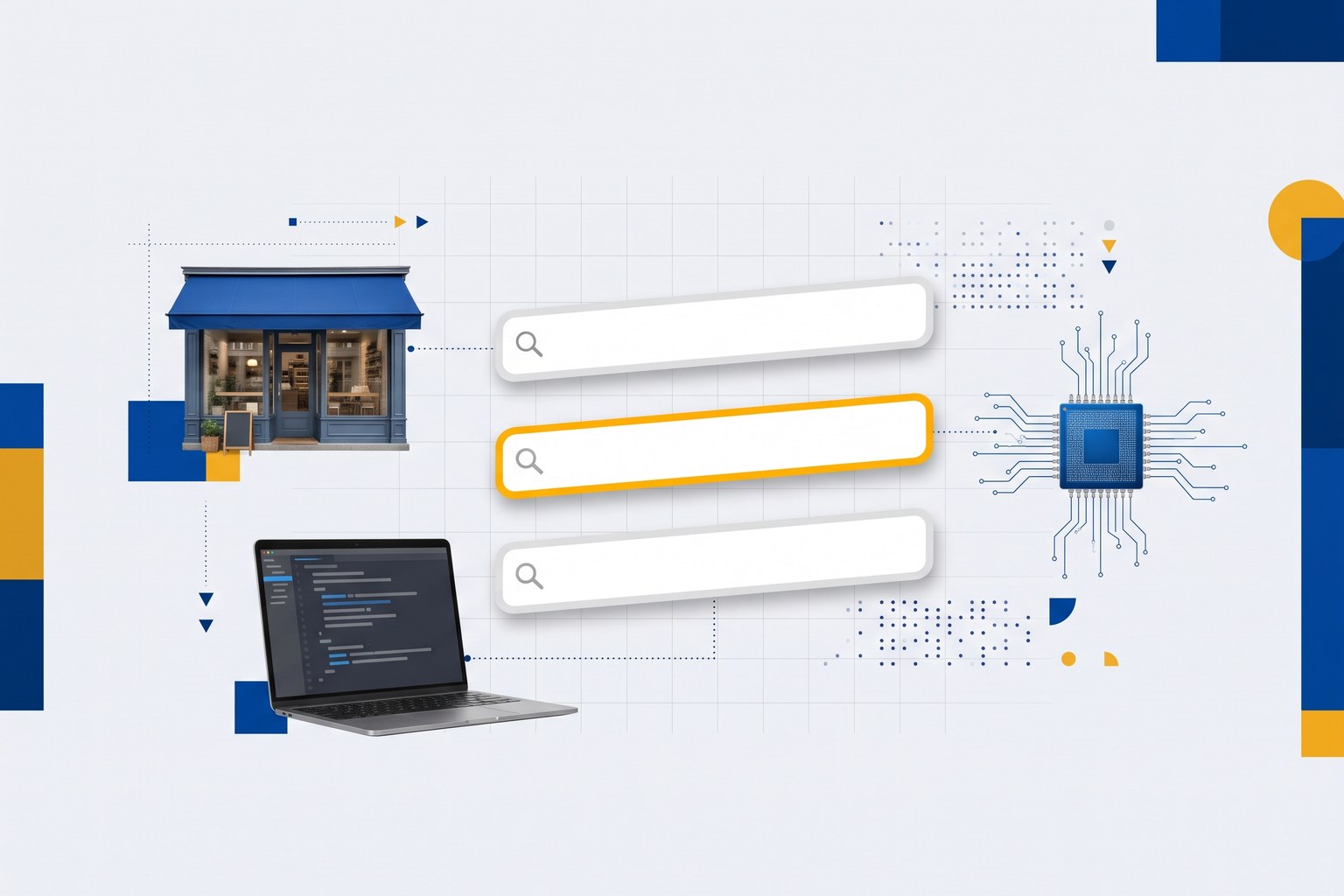

Quick answer: A domain name is the address people type to reach your website, like your-site-here.net. It stands in for the number computers use to find your site. You register it through a company called a registrar and keep it for as long as you renew it.
Below: what each part of a domain means, how it finds your website, what you get when you buy one, and what to do next.
What is a domain name, in plain terms?
Think of your website as a shop. Web hosting is the building, and the domain name is the street address on the sign. You can have the address before the building exists, but visitors need both to walk in.
Every computer on the internet is reached through a number called an IP address, such as 192.0.2.172. Those numbers are hard to remember and can change. Domain names give people a human-readable address for a web server, as Mozilla’s developer guide puts it. Our simple guide to IP addresses explains the number side.
What do the parts of a domain name mean?
A domain is read from right to left, and each part separated by a dot does a different job. Take www.your-site-here.net:
| Part | Name | What it does |
|---|---|---|
| .net | Extension, or top-level domain (TLD) | The ending. It hints at the kind of site or the country behind it |
| The middle part of your-site-here.net | The name you choose | The part that identifies your business |
| www | Subdomain | An optional prefix you control. You can create others, such as shop or blog |
Some extensions are generic, like .com and .net. Others are country codes, like .us. The IANA root zone database lists them all. Our guide to domain name suffixes helps you pick one,.
How does a domain name find your website?
The Domain Name System, or DNS, does the lookup. Cloudflare’s learning center calls DNS the phonebook of the internet: it translates the name a person types into the number a computer needs.
- Someone types your domain into a browser.
- The browser asks DNS which IP address goes with that name.
- DNS answers with the address of the server that holds your site.
- The browser connects to that server and loads your page.
This takes a moment and happens in the background. It also means you can move your site to a new host and keep your address, because only the link between the name and the number changes. ICANN explains the same point: a domain does not have to be tied to one particular computer.
What do you get when you buy a domain name?
You get the right to use the name for the term you pay for, as long as you keep renewing it. Three groups are involved:
- The registrar sells you the domain and manages it for you.
- The registry runs the extension. Verisign, for example, runs .com.
- ICANN draws up the contracts with registries and runs the accreditation system for registrars.
You also take on some duties. ICANN’s list of registrant rights and responsibilities says you must give accurate contact details and answer your registrar within 15 days when it asks.
A domain alone is not a website or an inbox. To show pages you need a site, and to send email you need a mail service. Tip: buy from a company that can do all three, so you have one login and one bill.
What comes with a domain from Turbify?
Every Turbify domain includes free WHOIS privacy, which keeps your personal contact details out of the public domain record, and Business Mail, so you can send email from the new address. It can also show a free one-page website built with AI, so the address works from day one.
When you are ready for a full site, Turbify web hosting includes the free AI Website Builder and a free domain for the first year on eligible .com, .net and .us names.
Quick answers
Is a domain name the same as a website?
No. The domain is the address and the website is what visitors see there. You can own one without the other.
Is a domain name the same as web hosting?
No. Hosting is where the files live. Our beginner’s guide to web hosting explains the rest.
Do I own my domain name forever?
No. You hold it for the term you pay for, and you keep it by renewing. If it lapses, someone else may be able to register it.
Can I change my domain name later?
You cannot edit a domain once it is registered, but you can register a new one and redirect the old one to it.
Your next step
Write down two or three names for your business, then run them through our domain name checklist before you search.
Your ideal domain name is a search away. Find it with Turbify’s AI Domain Search, with free WHOIS privacy and Business Mail included. Search for a domain.